
Non-Surgical Spinal Decompression in Williamsville, NY
Gentle, drug-free, non-invasive disc care on Main Street in Williamsville, led by Dr. Niccole Jefferlone and Dr. Matt Millanti. Call or text (716) 632-4476 to find out if you are a candidate.
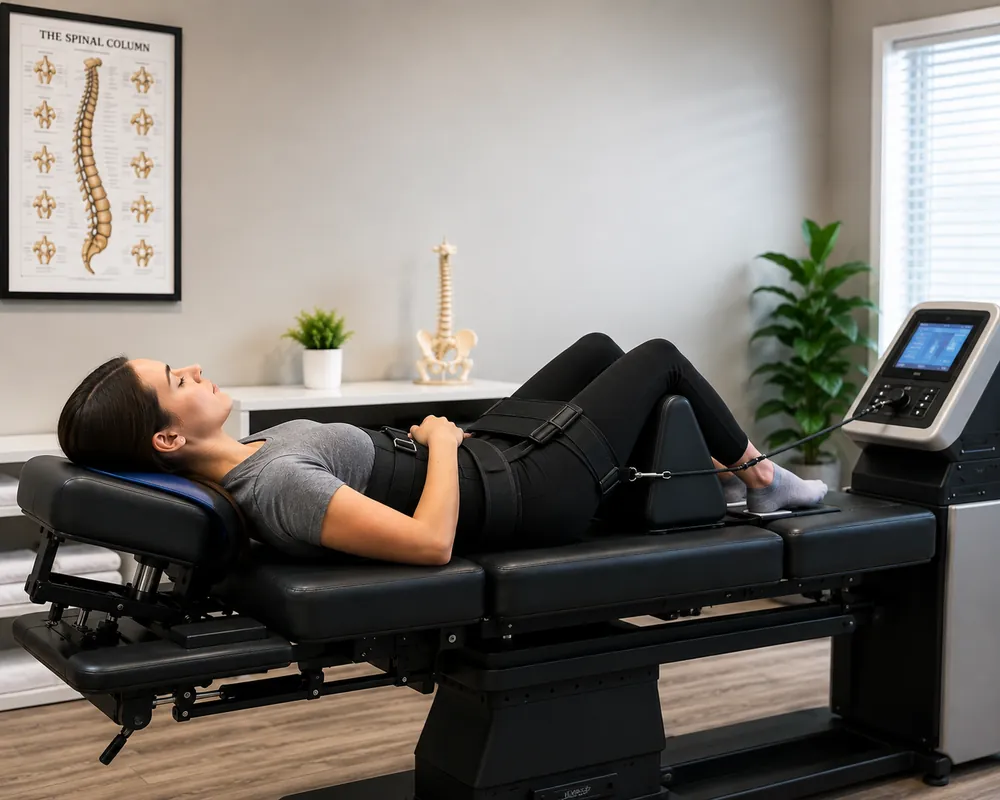
Quick answer: Non-surgical spinal decompression is a computer-guided table therapy that gently stretches and unloads the spine to create negative pressure inside a damaged disc. That change in pressure is intended to draw herniated or bulging disc material inward, take pressure off an irritated nerve root, and let fluid and nutrients move back into the disc. At Munroe Chiropractic in Williamsville, NY, a typical visit runs about 40 minutes, with roughly 28 of those minutes spent resting comfortably on a heavily padded decompression table through gentle alternating cycles. Our table uses technology derived from the DRX-9000 design, and the program is led by Dr. Niccole Jefferlone, D.C. and Dr. Matt Millanti, D.C. There is no medication, no injection and no surgery involved. To find out whether spinal decompression in Williamsville, NY is right for your back or neck, call or text (716) 632-4476.
What Non-Surgical Spinal Decompression Is
If you have been living with a herniated disc, a bulging disc, or sciatic pain that keeps returning no matter what you try, non-surgical spinal decompression may be the option you have not been offered yet. At Munroe Chiropractic, P.C. on Main Street in Williamsville, NY, decompression is our flagship service. It is a motorized, computer-controlled therapy that applies a precise, gradually building pull along the axis of your spine, then eases off, then builds again. Our table is built on technology derived from the DRX-9000 design, engineered specifically to unload the lumbar and cervical discs in a controlled way rather than simply pulling on the whole body.
The word people usually reach for is traction, and the two are related, but they are not the same thing. Old-style traction pulls with steady force, and the body tends to answer that steady pull by guarding: the paraspinal muscles tighten to protect the segment, and much of the intended stretch is absorbed before it ever reaches the disc. A decompression system works in cycles instead. The pull rises smoothly, holds, and releases in a repeating rhythm that is designed to stay under the threshold that triggers that protective muscle response, so more of the force can reach the disc level being targeted.
Because it is non-invasive and drug-free, decompression fits naturally into the kind of hands-on care Munroe Chiropractic has provided in Williamsville since 1987. There are no incisions, no injections, and nothing to recover from afterward. Most patients drive themselves to the appointment and drive themselves home.
- Computer-guided, cycle-based distraction rather than constant-force pulling
- Technology derived from the DRX-9000 design, built for lumbar and cervical discs
- Non-invasive, drug-free and performed fully clothed
- Program led by Dr. Niccole Jefferlone, D.C. and Dr. Matt Millanti, D.C.
- Available six days a week at our Williamsville, NY office
How Spinal Decompression Works Inside the Disc
A healthy intervertebral disc is a pressurized cushion. It has a tough outer ring and a gel-like center that holds water, and it lives under constant compressive load from gravity, posture and movement. When the outer ring weakens or tears, that inner material can push outward, press against a nerve root, and produce the deep ache, the burning, or the shooting leg or arm pain that brings people into our office. Compression also makes it harder for the disc to do the one thing it needs to do to heal, which is exchange fluid and nutrients with the tissue around it. Discs have very little direct blood supply, so they depend on that pressure-driven exchange.
Research on non-surgical decompression describes the mechanism this way: the cyclical distraction is intended to lower the pressure inside the nucleus of the disc into the negative range, which is a meaningfully different environment than the disc normally experiences. Published work on the approach has reported intradiscal pressures well below zero during treatment, along with widening of the opening where the nerve root exits. The working theory, and it is a theory that continues to be studied, is that this negative pressure creates a gradient that encourages displaced disc material to migrate back toward the center while allowing water, oxygen and nutrients to move in.
We want to be straightforward with you about the evidence. Case series and cohort studies in the chiropractic and rehabilitation literature have reported good outcomes for many patients, including reduced pain and, in some imaging studies, measurable changes in herniation size and disc height. Larger, higher-quality trials are still needed, and no honest clinic can promise you a specific result. What we can tell you is that decompression is conservative, low-risk for appropriate candidates, and worth a serious look before anyone starts talking to you about surgery.
Conditions We Treat With Spinal Decompression in Williamsville, NY
Decompression is a disc-focused therapy, so it is most often recommended when your history, examination and imaging point to a disc or a nerve root as the source of the problem. That includes people whose pain sits in the low back but travels down the buttock and leg, and people whose neck pain radiates into the shoulder, arm or hand. It also includes patients whose main complaint is stiffness and a deep, grinding ache that worsens with sitting, driving or standing in one place.
Patients come to our Williamsville office with decompression in mind for a range of related problems. Some have had an MRI already. Others simply know that something changed after a lift, a fall, a car accident or a long stretch at a desk, and the pain never fully went away. Either way, the first step is the same: figure out what is actually generating the pain before choosing a therapy for it.
Not every back problem is a disc problem, and that matters. Sacroiliac joint irritation, facet joint pain, hip pathology, and simple muscular strain can all mimic disc symptoms, and none of them are best served by decompression. Part of the value of a real examination is ruling those in or out.
- Herniated disc in the lumbar or cervical spine
- Bulging or protruding discs
- Sciatica and radiating leg pain
- Degenerative disc disease and lost disc height
- Spinal stenosis with nerve root or canal narrowing
- Chronic low back pain and chronic neck pain
- Whiplash and auto accident disc injuries
- Arm, hand or shoulder pain traced to a cervical disc
- Continued pain after a previous back surgery, when appropriate and cleared
What a Decompression Session Feels Like, Minute by Minute
Plan on roughly 40 minutes at the office for a decompression visit, with about 28 of those minutes spent on the table itself. You stay fully clothed, so wear something comfortable that you can move in. A member of our team positions you on a heavily padded table, either face up or face down depending on the segment we are treating and what your body tolerates best, and fits a harness system that anchors the pelvis or, for cervical work, cradles the head and neck.
Once you are set, the system runs its cycles. The pull builds slowly, holds, and eases back off, over and over, guided by the settings your doctor selected for your specific level and body type. Most patients describe the sensation as a gentle stretch through the low back or neck, and many say it is genuinely relaxing. It should not be painful. If anything feels sharp or wrong at any point, you tell us and we stop or adjust immediately. There is a hand-held patient control for exactly that reason.
After the session, you rest for a moment while the harness comes off, and then you are done. Some patients feel lighter or looser right away. Others feel a mild soreness that day, similar to what you might feel after a new stretch, which usually settles quickly. Depending on your plan, your doctor may pair the session with an adjustment, cold laser therapy, or specific home instructions before you leave.
- About 40 minutes total, roughly 28 minutes of active table time
- Fully clothed, lying down, no needles and no medication
- Gentle alternating pull-and-release cycles set by your doctor
- Hand-held patient control so you can stop the session at any time
- No sedation and no recovery time, so you drive yourself home
Your Consultation and Care Plan at Our Williamsville, NY Office
We do not put anyone on the decompression table on day one without understanding the problem first. A new patient visit starts with a real conversation: when the pain began, what makes it better or worse, what you have already tried, whether the pain travels, and whether anything has changed in your strength, sensation or reflexes. From there your doctor performs an orthopedic and neurological examination, checks how your spine actually moves, and looks for the pattern that fits your symptoms.
When it will change the plan, we take digital X-rays on site, which means no second appointment somewhere else and no waiting on a film to be sent over. If your presentation calls for advanced imaging, or if you already have an MRI report, we will review it with you and explain what it does and does not mean in plain language. Plenty of people arrive convinced that a word on a radiology report has sentenced them to surgery, and that is often not the case at all.
If decompression is appropriate, your doctor will explain the recommended number of visits and how they are typically spaced, usually more frequent at the start and tapering as you respond. Care is reassessed as you go, not set in stone at the beginning. If you are not responding the way we expect, we will tell you and we will change course, including referring you out when that is the right thing to do. New patient paperwork can be completed ahead of time on our Forms page, and to get started, call or text (716) 632-4476.
Who Is a Good Candidate for Spinal Decompression
The best candidates tend to be adults with disc-related pain that has hung on despite rest, medication, exercise or other conservative care, and whose examination points clearly to a disc or nerve root. People with sciatica from a lumbar herniation, with a cervical disc sending pain into the arm, or with degenerative changes and lost disc height often fit this description well. Being in pain for months does not disqualify you. Many of the patients who do best with decompression have been dealing with the problem for a long time.
There are also situations where decompression is not the right call, and being honest about them is part of practicing responsibly. Certain conditions are considered contraindications in the clinical literature, and part of your examination is screening for them. If any of these apply to you, we will say so directly and talk about what makes better sense, whether that is another approach in our office or a referral.
This is exactly why the consultation matters. Candidacy is not a checkbox on a form. It is a clinical judgment made by a doctor who has examined you and reviewed your imaging.
- Generally appropriate: disc herniation, disc bulge, degenerative disc disease, stenosis-related nerve compression, and persistent sciatica
- Screened carefully or ruled out: spinal fracture, advanced osteoporosis, spinal infection or tumor, abdominal aortic aneurysm, and surgically implanted spinal hardware such as rods or screws
- Evaluated case by case: pregnancy, very recent spinal surgery, and severe or progressing neurological deficits including significant weakness or any change in bowel or bladder control
- Worth telling us about right away: pain that increases during or after a session, which often means decompression is not the right therapy for that patient
How Decompression Fits With Hands-On Chiropractic Care
Decompression is a strong tool, but it is rarely the whole answer on its own. A disc that has been irritated for months usually sits inside a spine that has stopped moving well, surrounded by muscles that have been guarding and compensating for just as long. That is why our doctors most often use decompression as part of a broader, hands-on plan rather than as a standalone machine treatment. Munroe Chiropractic has been a hands-on practice since 1987, and that has not changed.
Depending on what your examination shows, your plan may combine table sessions with specific chiropractic adjustments, soft tissue work, or supportive therapies. Our doctors use a wide range of techniques, including Diversified, Thompson Drop, Flexion-Distraction, Trigger Point Therapy, Sacro-Occipital Technique, Seated Cervical, Traction, Toggle, and Active Release Technique. Flexion-Distraction in particular is a manual, doctor-guided technique that shares some family resemblance with decompression and is often useful alongside it.
We also teach you what to do between visits. Sitting posture, how you get in and out of your car, how you lift, how you sleep, and a small number of targeted movements can make a real difference in whether progress holds. The goal is not to make you dependent on a table. The goal is to calm the disc down, restore normal motion, and give you back the ability to do your day without thinking about your back.
- Chiropractic adjustments to restore motion to the segments above and below the injured level
- Soft tissue and trigger point work for the muscles that have been guarding
- Cold laser therapy when inflammation is a limiting factor
- Home instructions for posture, lifting, sitting and sleeping
- Reassessment as you progress, with the plan adjusted to your response
Auto Accident, Work Injury and Personal Injury Care in Williamsville, NY
Disc injuries do not only come from wear and tear. A rear-end collision on Main Street, a slip on an icy Williamsville parking lot in February, or a lifting injury on the job can all produce a herniated or bulging disc, and the symptoms often do not show up in full until a day or two later. Munroe Chiropractic has particular expertise in no-fault, workers' compensation and personal injury care, and we have been handling these cases for decades.
That experience matters more than people expect. These cases come with documentation requirements, examination findings that need to be recorded properly, and communication with insurers, attorneys and case managers. Our team knows how to handle that side of it so you can focus on getting better instead of chasing paperwork. If your case involves an auto accident or a work injury, tell us when you call or text and we will walk you through what we need.
If a disc injury from a crash or a workplace incident is the source of your pain, spinal decompression may be part of the plan alongside adjustments and rehabilitation. As always, the treatment follows the examination, not the other way around.
Why Williamsville, NY Patients Choose Munroe Chiropractic
Munroe Chiropractic, P.C. has served Williamsville and the surrounding Western New York communities since 1987, and more than 40,000 patients have come through our doors in that time. In 2026 we became part of the Complete Care Chiropractic family, which means the same team continues in the same office at 6035 Main Street in Williamsville, NY 14221. Our tagline, Experience. Quality. Compassion., is not marketing language we picked at random. It is a description of how we have run this practice for close to four decades.
Our decompression program is led by Dr. Niccole Jefferlone, D.C., the practice owner, and Dr. Matt Millanti, D.C., who has spent ten years here and has extensive experience with non-surgical spinal decompression. They are joined by Dr. Safeya Muhammad, D.C., who is CACCP certified through the ICPA, Webster Technique certified and Spinning Babies trained, with a focus on prenatal, pediatric and family care over her eleven years at the practice, and by Dr. Megan Berndt, D.C., who joined in 2026 with a master's degree in sports rehabilitation and prior experience performing acupuncture in Minnesota.
We are also open when working people can actually get here. Our hours are Monday through Friday from 8:00am to 7:00pm, closed from 1:00pm to 2:00pm for lunch, and Saturday from 8:00am to 2:00pm. That is six days a week, including early mornings, evenings and Saturdays, which matters when you are fitting a decompression schedule around a job, a commute or a family. If you are wondering whether spinal decompression in Williamsville, NY could help your back or neck, the next step is simple. Call or text us at (716) 632-4476 and we will talk it through.
- Serving Williamsville, Amherst, Clarence, Buffalo and Western New York since 1987
- More than 40,000 patients helped since 1987
- On-site digital X-rays, no separate imaging appointment
- Open six days a week with early morning, evening and Saturday hours
- Special expertise in no-fault, workers' compensation and personal injury care
- Drug-free, non-invasive, hands-on care from four licensed doctors of chiropractic
Spinal Decompression Hours
Decompression runs on its own schedule at our Williamsville office, separate from general chiropractic hours. Call or text (716) 632-4476 to find a time.
| Monday | 8:00am to 7:00pm |
|---|---|
| Tuesday | 8:00am to 1:00pm |
| Wednesday | 8:00am to 1:00pm |
| Thursday | 8:00am to 7:00pm |
| Friday | 2:30pm to 6:30pm |
Frequently Asked Questions
Does spinal decompression hurt?
It should not. Most patients describe the sensation as a gentle stretch through the low back or neck, and a fair number find it relaxing enough that they close their eyes for the session. You stay fully clothed and lie on a heavily padded table while the system runs slow, alternating cycles. You also hold a patient control that lets you stop the session yourself at any moment. If a treatment causes pain during or after, that is important information and often a sign that decompression is not the right therapy for you, so tell us right away and we will reassess.
How long is a spinal decompression appointment, and how many will I need?
Plan on about 40 minutes at our Williamsville, NY office, with roughly 28 minutes of that spent on the table. The number of visits depends on your diagnosis, how long you have had the problem, and how your body responds. Programs are typically more frequent at the beginning and taper as you improve, and the total course is usually measured in weeks rather than a handful of visits. Your doctor will lay out a specific recommendation after your examination, and we reassess as you go rather than locking you into a fixed number up front. Call or text (716) 632-4476 to get started.
Is this the same as traction or using an inversion table at home?
No. Traction applies steady, constant force, and the body tends to respond by tightening the surrounding muscles, which absorbs much of the pull before it reaches the disc. A decompression system uses computer-guided cycles that build and release, which is designed to work under that guarding response so more of the force reaches the targeted level. An inversion table is a different thing again. It uses gravity and body weight without control over the level being treated, the amount of force, or the timing. Our table uses technology derived from the DRX-9000 design and is set specifically for your spine by your doctor.
How do I know if I am a candidate for spinal decompression?
The only reliable way to find out is an examination. Your doctor will take a full history, perform orthopedic and neurological testing, and review imaging, including digital X-rays taken here when they will change the plan. Good candidates generally have disc-related pain that has persisted despite other conservative care. Certain conditions rule decompression out, including spinal fracture, advanced osteoporosis, spinal infection or tumor, abdominal aortic aneurysm, and implanted spinal hardware such as rods or screws. Pregnancy, very recent surgery and significant neurological deficits are evaluated individually. Call or text (716) 632-4476 to arrange a consultation.
Can spinal decompression help me avoid back surgery?
We cannot promise that, and you should be cautious about anyone who does. What we can say is that decompression is a conservative, non-invasive option that many people have not tried before surgery is raised as a possibility, and published case series and cohort studies have reported good outcomes for appropriate patients, including reduced pain and, in some imaging studies, measurable changes in disc height and herniation size. The research base is still developing. Our approach is to examine you honestly, tell you what we think decompression can and cannot do in your situation, and refer you out if a surgical consultation is genuinely the right next step.
Will I still get adjusted while I am doing decompression?
Usually yes, and that is often the point. A disc that has been irritated for months typically sits in a spine that has lost normal motion, with muscles that have been guarding to protect it. Our doctors commonly pair table sessions with hands-on chiropractic adjustments, soft tissue and trigger point work, and sometimes cold laser therapy when inflammation is limiting progress. Techniques used here include Diversified, Thompson Drop, Flexion-Distraction, Sacro-Occipital Technique, Seated Cervical, Toggle and Active Release Technique. Your specific combination depends on what your examination shows.
Does insurance cover spinal decompression?
Coverage varies by plan and by the type of claim involved. Cases connected to an auto accident under no-fault, or to a workplace injury under workers' compensation, are handled differently than standard health insurance, and we have decades of experience with all three at this office. Rather than guess, call or text us at (716) 632-4476 with your information and our team will review your specific situation and explain your options clearly before you commit to anything.
Do I need an MRI before starting spinal decompression?
Not always. Many patients begin with a thorough history and examination plus digital X-rays taken on site, which is often enough to determine whether decompression is appropriate. If your presentation suggests advanced imaging is needed, your doctor will tell you and help arrange it. If you already have an MRI report, bring it with you. We will go through it with you in plain language, because a report full of clinical terminology often sounds far more alarming than what it actually means for your care.
Wondering if non-surgical spinal decompression in Williamsville, NY is right for you? Call or text Munroe Chiropractic at (716) 632-4476. We are open six days a week at 6035 Main Street, Williamsville, NY 14221.