
Chiropractic Adjustment in Williamsville, NY
Precise, hands-on spinal adjustments from a Williamsville chiropractic team that has cared for more than 40,000 patients since 1987. Experience. Quality. Compassion.
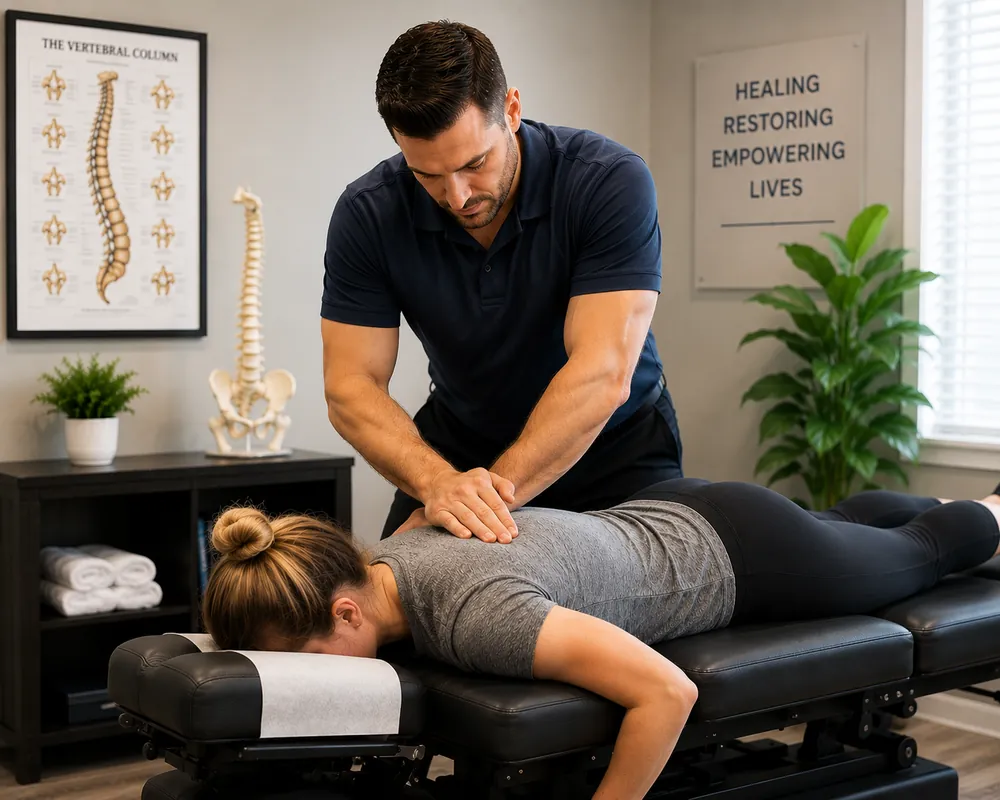
Quick answer: A chiropractic adjustment is a precise, hands-on movement applied to a spinal or extremity joint that has lost normal motion. The goal is to restore that motion, ease muscle guarding and calm irritated tissue without drugs or surgery. At Munroe Chiropractic in Williamsville, NY, the adjustment is chosen for your body and your exam findings, not applied from a script. To get started, call or text (716) 632-4476.
What a Chiropractic Adjustment Actually Is
A chiropractic adjustment, also called spinal manipulation, is a specific and controlled movement applied by hand to a joint that is not moving the way it should. Most adjustments use what the research literature calls a high-velocity, low-amplitude thrust, which simply means the doctor applies a quick, shallow, carefully aimed force rather than a slow stretch or a heavy push. The speed is what makes it work. Because the movement is fast, the amount of force needed stays small, and the joint is carried through a range it has stopped reaching on its own.
The word people usually attach to an adjustment is "crack," and that word does the technique a disservice. An adjustment is not a random twist, and it is not an attempt to force something back into place. Your doctor of chiropractic examines the spine segment by segment, finds the levels that are stiff, tender or moving poorly, and treats only those levels. Everything about the contact is deliberate: which joint, which direction, how much depth, whether the table assists, and whether a thrust is appropriate for you at all on that particular day.
At Munroe Chiropractic in Williamsville, NY, adjusting has been the foundation of the practice since 1987. It is hands-on care, it is drug-free, and it is non-invasive. Nothing is injected, nothing is cut, and nothing is prescribed to mask the signal your body is sending. The intent is to change how the joint moves so the tissue around it has a reason to settle down.
- An adjustment is specific to a joint, not general to a whole region
- It is delivered by hand, often with help from a specialized table
- It is drug-free and non-invasive
- The force stays low because the speed is high
- Not every visit and not every patient calls for a thrust-style adjustment
How an Adjustment Works: Joint Motion and the Nervous System
Spinal joints are built to glide. Each vertebra pairs with the one above and below at small facet joints, and those joints are wrapped in a capsule that is dense with nerve endings. When a segment stops gliding freely, whether from an injury, a fall, a car accident, a repetitive work posture or years of sitting, the capsule and the surrounding muscles respond. The muscles tighten protectively, the segment stiffens further, and the joint sends a steady stream of irritated input into the nervous system. That loop is what patients describe as a nagging, locked, catching kind of pain that never fully clears on its own.
An adjustment interrupts that loop. Separating the joint surfaces briefly changes pressure inside the capsule and floods those nerve endings with new movement information. Researchers studying spinal manipulation have measured short-term changes in pain sensitivity, muscle activity and segmental motion afterward. The National Center for Complementary and Integrative Health, part of the National Institutes of Health, reports that spinal manipulation may produce small improvements in pain and function for low back pain, and describes it as one of several useful options alongside exercise, massage and physical therapy. We would rather state that plainly than overpromise. Adjusting is a well-established conservative option, and it works best as part of a plan.
Because the spine houses and protects the nervous system, chiropractors have long been interested in how mechanical stress at a joint affects the nerves that travel nearby. When a segment is restricted and the tissue around it is irritated, nearby nerve roots can become sensitized, which is part of why a low back problem can send symptoms into the hip and leg, and why a neck problem can show up as headaches, shoulder tension or a heavy, tingling arm. Improving motion at the source is often what finally changes the symptom you feel downstream.
The Adjusting Techniques We Use in Williamsville, NY
No two spines respond to the same input. A twenty-two year old hockey player with a stiff mid-back and a seventy-eight year old with thinning bone density and years of arthritis both deserve care, and they should not receive the same adjustment. That is why our doctors are trained in a range of techniques, from classic hands-on thrusting to very gentle, low-force methods that never produce an audible release at all. Your findings, your comfort level and your health history decide which approach we use, and that choice can change from visit to visit.
Here is what each of our techniques means in plain language:
- Diversified: the classic hands-on adjustment most people picture, a quick and shallow thrust delivered by hand to a specific joint. It is one of the most widely used techniques in the profession.
- Thompson Drop: performed on a table with cushioned sections that release and drop a fraction of an inch as the thrust is delivered. The table absorbs much of the work, so the adjustment feels lighter while still opening the joint.
- Flexion-Distraction: a gentle, rhythmic, pumping traction performed on a moving table. There is no thrust at all. It is a favorite for disc-related low back pain and for patients who prefer a slower, quieter approach.
- Trigger Point Therapy: sustained manual pressure into a knotted, taut band of muscle to reduce its tone and its referred pain, used before or after the joint itself is addressed.
- Sacro-Occipital Technique (SOT): a low-force method focused on the relationship between the sacrum at the base of the spine and the occiput at the top of the neck, often using padded wedges and body positioning rather than thrusting.
- Seated Cervical: a neck adjustment performed while you sit upright with your head supported. Many patients who feel uneasy lying face down find the seated approach far more comfortable.
- Traction: sustained, gentle separation applied to the spine to decompress the joints and give irritated tissue room to settle.
- Toggle: a very light, precise, fingertip-driven adjustment used most often in the upper neck, where accuracy matters far more than force.
- Active Release Technique (A.R.T.): the doctor holds tension on a scarred or adhered muscle while you actively move the limb through a specific range, so the tissue is freed as it lengthens. Useful for sports injuries, repetitive-strain problems and stubborn tendon pain.
Conditions and Symptoms a Chiropractic Adjustment Can Help
Adjusting is a musculoskeletal treatment, so it makes the most sense for pain and dysfunction that begin in joints, discs, muscles and the nerves that travel among them. That covers a great deal of what walks through our door in Williamsville. Some patients arrive after a single sharp event, such as lifting a bag of mulch or getting rear-ended on Main Street. Others arrive after years of quiet accumulation from a desk, a delivery route or a factory line.
Munroe Chiropractic has particularly deep experience with injury cases. We handle no-fault auto accident care, workers' compensation claims and personal injury cases regularly, and we know how those files need to be documented so your care is not interrupted by paperwork. If you were hurt in a crash or on the job, being evaluated early matters. Whiplash injuries in particular can feel deceptively mild for the first day or two before stiffness, headaches and restricted motion set in.
Conditions our doctors commonly address with adjustments and supporting manual care include:
- Low back pain, mid-back pain and neck pain
- Headaches and migraines, including those associated with upper-neck tension
- Sciatica and radiating leg pain
- Herniated and bulging discs
- Spinal stenosis and degenerative disc disease
- Whiplash and other auto-accident injuries
- Sports injuries, sprains and strains
- Work injuries and repetitive-motion complaints
- Shoulder, arm, knee and leg pain
- Vertigo, plantar fasciitis, carpal tunnel symptoms and arthritis pain
What to Expect at Your First Visit in Williamsville, NY
A first visit at our Williamsville office is an evaluation before it is a treatment. We want to understand what happened, what makes it worse, what you have already tried and what you are actually trying to get back to, whether that is sleeping through the night, finishing a shift or getting back on the ice. New-patient paperwork is completed on our Paperwork page, so your appointment time is spent with the doctor rather than on a clipboard.
From there the visit follows a predictable path. You will always know what is happening before it happens, and you can stop at any point. Nothing is done to you without an explanation first, and if a technique makes you uncomfortable, we have several gentler ways to accomplish the same goal.
If imaging is warranted, we have digital X-ray on site, which means no second appointment at an outside facility and no waiting days for a report. Films are reviewed with you on the screen so you can see what we are describing. If the exam suggests your case would be better served by another provider or by advanced imaging such as MRI, we will tell you that honestly and help you get there.
- History and consultation: your symptoms, your injury, your work, your goals and your full health background
- Physical examination: posture, range of motion, orthopedic and neurological testing, and hands-on assessment of each spinal segment
- Digital X-rays on site when your history or exam indicates them
- Report of findings: what we found, what we believe is driving it, what we recommend and roughly how long it should take
- Treatment: the adjustment itself, plus any soft-tissue work, therapy or home instruction that supports it
- A plan: how often to come in, what to do at home, and what progress should look like
Is a Chiropractic Adjustment Safe, and What Does It Feel Like?
Most patients describe an adjustment as quick, oddly satisfying and far less dramatic than they expected. The contact itself lasts a fraction of a second. The popping sound many people associate with it is called cavitation. When the joint surfaces separate slightly, gas that is dissolved in the joint fluid rapidly forms a small cavity, and imaging studies have tied the sound to that moment of separation. It is not bone grinding on bone, and it is not anything breaking. It is also not required. Low-force methods such as Flexion-Distraction, SOT and Toggle frequently produce no sound at all and still restore motion.
Some soreness afterward is normal and usually mild, similar to how you feel the day after starting a new workout. It typically eases within a day or two. Spinal manipulation performed by a licensed, trained clinician is widely considered safe, and serious complications are rare. That said, safety comes from screening, not from luck. Certain conditions, including significant osteoporosis, inflammatory disease, recent fracture, active infection, tumor and some vascular conditions, either rule out a thrust-style adjustment or call for a modified, low-force approach. This is exactly why we take a thorough history, examine before we treat, and image when the picture warrants it.
Tell us everything. Blood thinners, a history of stroke, a bone-density diagnosis, a recent surgery, a pregnancy, a rheumatologic condition, a hardware implant: all of it changes what we do and how we do it. Our job is not to adjust every patient the same way. It is to choose the safest technique that will actually help you.
Who Is a Good Candidate for Chiropractic Care in Williamsville, NY
Most people with mechanical spine and joint pain are reasonable candidates for conservative, hands-on care, and that spans a wide age range. We adjust high school athletes, office workers who spend nine hours at a monitor, tradespeople, weekend runners, expectant mothers, infants and adults in their eighties. What changes across those groups is not whether care is appropriate but which technique is appropriate.
Family care is a real strength of this practice. Dr. Safeya Muhammad is CACCP certified through the International Chiropractic Pediatric Association, is Webster Technique certified and is Spinning Babies trained, with a focus on prenatal, pediatric and family care built over eleven years here. Pregnancy and pediatric adjustments look nothing like a classic adult thrust. They are gentle, low-force and specific to the body in front of her. Dr. Megan Berndt, who joined the practice in 2026, holds a master's degree in sports rehabilitation and brings a strong rehabilitation lens to athletic and repetitive-strain injuries. Dr. Matt Millanti, with ten years at the practice, and Dr. Niccole Jefferlone, the owner, carry extensive experience with disc and decompression cases.
You may be a particularly good fit for an evaluation if you recognize yourself in any of the following:
- Pain that has lasted more than a week or keeps returning in the same spot
- Stiffness that is worst in the morning or after sitting
- Headaches that start at the base of the skull
- Numbness, tingling or pain that travels into an arm or a leg
- A recent car accident, work injury or fall, even if the symptoms feel minor so far
- A preference for trying conservative, drug-free care before considering injections or surgery
How Adjustments Fit With the Rest of Your Care
An adjustment restores motion. On its own it does not undo a decade of forward head posture, rebuild a deconditioned core or resolve every disc problem. That is why adjusting at Munroe Chiropractic is almost always paired with something else. Soft-tissue work such as Trigger Point Therapy and Active Release Technique addresses the muscle side of the problem so the joint has a better chance of holding its correction. Home instruction, movement advice and simple ergonomic changes address the reason the segment locked up in the first place.
For disc-related and stenosis cases, our flagship service is Non-Surgical Spinal Decompression, delivered on technology derived from the DRX-9000 design and led by Dr. Niccole Jefferlone and Dr. Matt Millanti. Decompression and adjusting complement each other well. Decompression works at the disc level over a series of sessions, while adjusting keeps the surrounding joints moving so the region does not simply stiffen again. Many of our patients receive both.
Care is also staged. Early visits are usually about calming symptoms and are scheduled more closely together. As pain settles, the focus shifts toward restoring normal motion and stability, and visits spread out. Some patients then choose ongoing wellness care to stay ahead of flare-ups, and some finish their plan and come back only when something changes. We will make a recommendation and explain the reasoning, and the decision is always yours.
Why Williamsville Patients Choose Munroe Chiropractic
Munroe Chiropractic, P.C. has been adjusting spines at 6035 Main Street in Williamsville since 1987, and more than 40,000 patients have come through these doors in that time. Longevity in one location means something in a field like this. It means the doctors here have seen the same injuries hundreds of times, know which cases respond quickly and which need a longer runway, and have working relationships with the primary care offices, imaging centers and attorneys our patients deal with. Since 2026 the practice has been part of the Complete Care Chiropractic family, with the same team and the same Main Street location.
Access matters too. We are open six days a week: Monday through Friday from 8:00am to 7:00pm, closed from 1:00pm to 2:00pm for lunch, and Saturday from 8:00am to 2:00pm. Early mornings, evenings and Saturday hours exist so that care fits around a work schedule instead of competing with it. We are minutes from Amherst, Clarence and the rest of the Buffalo area, with parking right at the door.
We also handle the cases many offices shy away from. No-fault auto accident care, workers' compensation and personal injury are everyday work here, and the documentation gets done correctly the first time. Add on-site digital X-ray, four doctors with distinct areas of depth, and techniques that range from firm and classic to feather-light, and you have a practice that can meet almost any patient where they are. Experience. Quality. Compassion. That has been the standard since 1987, and it is still how care is delivered today. Call or text (716) 632-4476 to get started.
- Serving Williamsville, NY at the same Main Street address since 1987
- More than 40,000 patients helped
- Open six days a week, including Saturday from 8:00am to 2:00pm
- No-fault, workers' compensation and personal injury experience
- On-site digital X-ray, with no trip to an outside imaging center
- Four doctors covering family, prenatal, pediatric, sports and disc care
- Hands-on, drug-free, non-invasive treatment
- Scheduling by phone or text at (716) 632-4476
Frequently Asked Questions
Does a chiropractic adjustment hurt?
For most patients, no. The adjustment itself is quick and is usually described as a pressure or a release rather than pain. If an area is already inflamed, the setup position can be tender for a moment. Mild soreness for a day or two afterward is common, especially after a first visit, and it feels similar to starting a new exercise routine. If you are anxious about discomfort, tell your doctor. We use several low-force techniques, including Flexion-Distraction, SOT and Toggle, that involve no thrusting at all.
What is the popping sound, and does it have to happen?
That sound is called cavitation. When a joint is separated slightly, gas dissolved in the joint fluid rapidly forms a small cavity, and imaging research has linked the sound to that moment of separation. Nothing is cracking, breaking or grinding. The sound is also not a measure of success. Plenty of effective adjustments make no sound whatsoever, and several of the techniques we use in Williamsville are designed to restore motion quietly.
How many visits will I need?
It depends on what is wrong, how long it has been going on and what else is happening in your health. A recent, uncomplicated strain often responds in a handful of visits. A disc problem, a whiplash injury from an auto accident or a condition that has been building for years generally takes longer, is scheduled more closely at first, then tapers as you improve. After your examination we will give you an honest recommendation and explain the reasoning behind it. We will also tell you if we do not think chiropractic care is the right answer for your case.
Do I need X-rays before an adjustment?
Not always. X-rays are ordered when your history or examination indicates them, such as after a car accident or a fall, with certain neurological findings, with suspected arthritis or bone-density concerns, or when symptoms are not behaving the way we would expect. We have digital X-ray on site in Williamsville, so there is no separate trip to an imaging center and no long wait for results. Your films are reviewed with you on screen so you can see exactly what we are describing.
Is chiropractic adjustment safe?
Spinal manipulation performed by a licensed, trained clinician is generally considered safe, and serious complications are rare. Safety comes from proper screening, which is why we take a full history and examine you before treating. Some conditions, including significant osteoporosis, recent fracture, active infection, certain inflammatory and vascular conditions and some tumors, either rule out a thrust-style adjustment or call for a gentler approach. Please tell us about every diagnosis, medication and surgery, including blood thinners and any history of stroke, so we can choose the safest effective technique for you.
Can I be adjusted while pregnant, and can my child be adjusted?
Yes, and both are done very differently from a standard adult adjustment. Dr. Safeya Muhammad is CACCP certified through the International Chiropractic Pediatric Association, is Webster Technique certified and is Spinning Babies trained, with a focus on prenatal, pediatric and family care. Prenatal and pediatric adjustments are low-force, gentle and specific, using positioning and specialized tables rather than heavy thrusting. Let us know that you are pregnant, or how old your child is, when you call or text so we can schedule you with the right doctor.
I was in a car accident or hurt at work. Do you handle those cases?
Yes. No-fault auto accident care, workers' compensation and personal injury cases are a long-standing part of what we do at Munroe Chiropractic. We are experienced with the examinations, documentation and reporting these claims require, so your treatment is not derailed by paperwork. If you were in a crash, do not wait for symptoms to declare themselves. Whiplash injuries often feel minor for the first day or two before stiffness, headaches and reduced motion set in. Call or text (716) 632-4476 and we will get you evaluated.
How do I make an appointment at your Williamsville office?
Call or text (716) 632-4476. We handle scheduling by phone and text on purpose, because it lets us ask a few questions and match you with the right doctor and the right amount of time. We are open Monday through Friday from 8:00am to 7:00pm, closed 1:00pm to 2:00pm for lunch, and Saturday from 8:00am to 2:00pm. New-patient paperwork is completed on our Paperwork page. Our office is at 6035 Main Street, Williamsville, NY 14221, convenient to Amherst, Clarence and the greater Buffalo area.
Ready for hands-on, drug-free care in Williamsville, NY? Call or text Munroe Chiropractic at (716) 632-4476 to schedule your visit.